
Why a 0.85-Inch IPS Panel Fits Readout Designs
A 0.85-inch IPS panel at SPI fits a small customer-facing readout better than people expect, provided a few fit checks are done before the mechanical design is frozen. Treat the display as one subsystem among several and the work becomes a checklist rather than a mystery: verify the physical layer, pin the software order, and validate against the conditions of counter-top POS units.
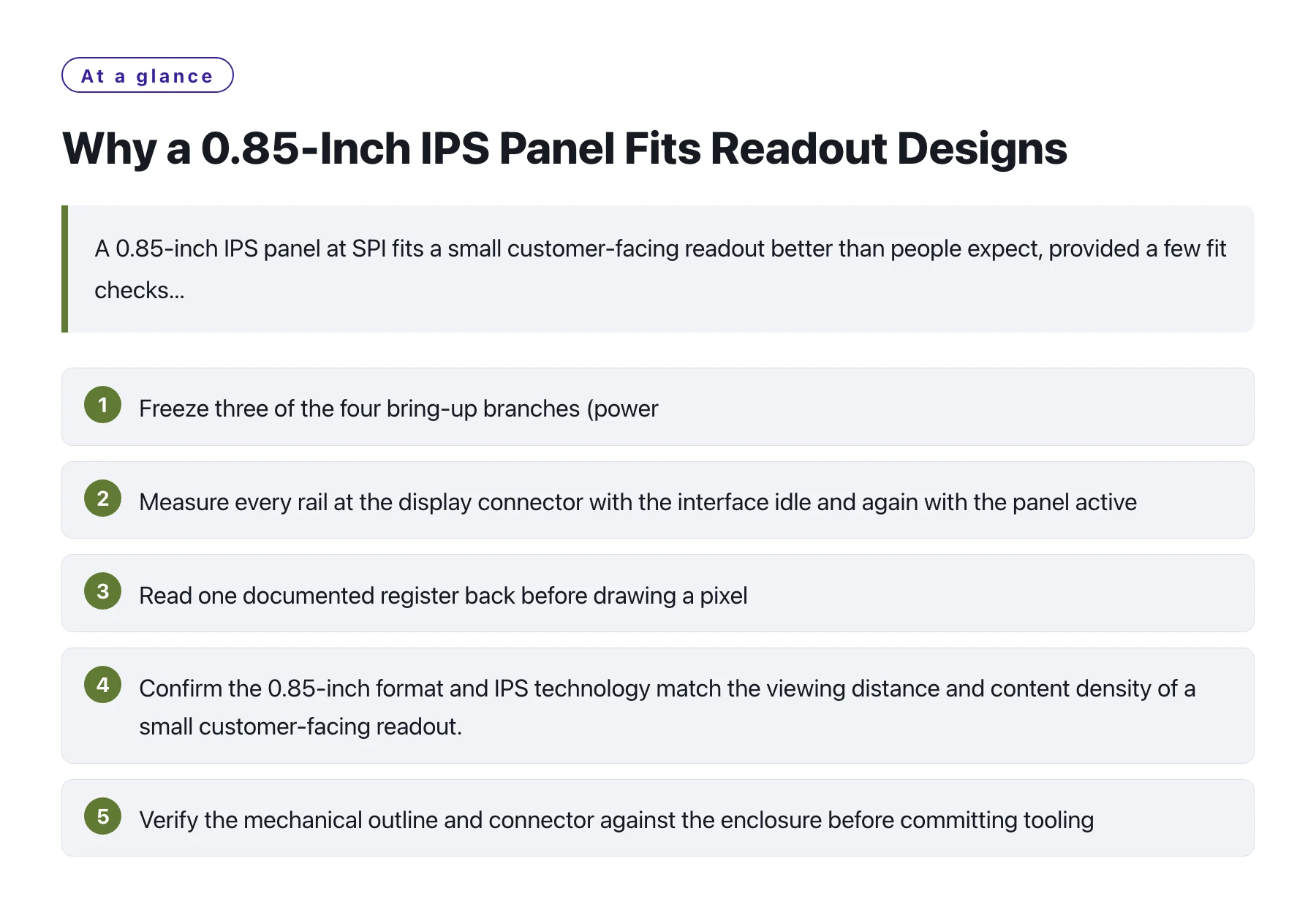
Key takeawaysFreeze three of the four bring-up branches (power, control, configuration, data) and vary one at a time, because changing several things between tests leaves you with a working board and no explanation. [1] · Measure every rail at the display connector with the interface idle and again with the panel active, since a rail that only sags under load points at the harness rather than the code. [2] · Read one documented register back before drawing a pixel; a correct reply proves most of the physical link and costs minutes of bench time. [3] · Confirm the 0.85-inch format and IPS technology match the viewing distance and content density of a small customer-facing readout. [4] · Verify the mechanical outline and connector against the enclosure before committing tooling, because a millimetre of interference is expensive to fix later.
A 0.85-inch IPS panel at 128x128 resolution sits in an awkward but useful middle ground: large enough to show real information, small enough to drop into a crowded front panel. The SPI interface keeps the host pin count low, and the module form factor hides the controller, the bias circuitry and the timing generation behind a simple command set.
In a counter-top POS units the display is rarely the hard part of the design. The hard part is everything around it: the supply that must stay clean while grease and high transaction rate are present, the harness that reaches the panel without picking up noise, and the software that brings the controller up in the right order. Getting those right separates a demo from a product.
This article works through the practical questions for a small customer-facing readout: what to verify before commitment, how the SPI link behaves under real conditions, and where teams commonly lose time. The product facts used here come only from the module's published description; nothing is assumed beyond size, resolution, interface and technology.
What must be true before a 0.85-inch IPS panel works in counter-top
Four conditions have to hold at once: the logic supply must be present and in range, the reset must have released after that supply settled, the controller must have accepted a valid configuration, and the data path must deliver bits the panel can interpret. When any one is false the visible result is the same dark or frozen screen, which is why a fixed order is worth more than a clever idea.
In counter-top POS units those conditions are harder than on the bench. Grease and high transaction rate push the supply and the harness in ways a desktop test never shows. The panel's own technology, IPS, decides how the bias is generated and what the controller expects before the first pixel.
The control channel is the only window you have into the part. Read one documented value back before writing a single pixel and write down what you read; that one measurement separates a wiring fault from a configuration fault faster than any amount of recompiling.
Why a 0.85-inch IPS panel fits a small customer-facing readout
The 0.85-inch format and 128x128 resolution land at a useful density for a small customer-facing readout: enough to show status, a menu or a small map without a controller that pushes cost and power up. The SPI interface keeps the host simple.
The fit checks that matter are viewing distance, content density and the mechanical outline. Skip them and the panel is either unreadable at arm's length or does not seat in the bezel, both of which surface late and expensively.
Decision checklist for a 0.85-inch IPS panel in counter-top
| Question | Why it matters | Confirm before |
|---|---|---|
| Viewing distance vs size | Readability at use | mechanical freeze |
| SPI load on host | Pin and timing budget | schematic |
| Environment stressors | Field survival | grease qualification |
| Spare and second source | Supply continuity | volume order |
| Test coverage | Return rate | production start |
The IPS technology behind a 0.85-inch panel
IPS defines how the panel generates and holds an image, which in turn sets the bias needs, the contrast behaviour and the way the controller must be initialised. Understanding that chain prevents the common mistake of treating every small panel as interchangeable.
For a 128x128 panel the frame buffer and the transfer size are small, so the interface is rarely the bottleneck. The interesting constraints are electrical and mechanical: the supply quality, the harness, and how the module seats in the final enclosure.
Why IPS suits a small customer-facing readout
The combination of IPS and the 0.85-inch format matches a small customer-facing readout because it balances readability, power and mechanical volume better than a larger or a denser alternative would.
What SPI asks of the host
The SPI link asks for a clean clock, correct level translation and a disciplined chip-select or address plan. Get those and the panel behaves; skip them and the symptoms look like a faulty part.
Evaluating a 0.85-inch IPS panel for your build
Before committing the layout, gather the controller register map, the reference init code and the mechanical drawing, and confirm the SPI electrical levels against your host. A short evaluation on the actual harness saves weeks later. Engineers qualifying a compact panel often start from 0.85" IPS display 128x128 because the init code and breakout board already exist, which removes the longest stretch of a bring-up.
Keep the evaluation disciplined: change one thing at a time, record the clock, the sequence and the rail measurements that produced first light, and treat that record as the reference configuration for the project. Every later change is then measured against a known-good baseline.
Write down the exact sequence, clock rate and rail measurements that produced first light on the 0.85-inch IPS panel. It becomes the reference configuration, and every later change, a new revision, a different host or a cheaper harness, is measured against a known-good baseline instead of against memory.
Sources
Frequently asked questions
How do I tell a wiring fault from a configuration fault on a 0.85-inch IPS panel?
Try to read a documented register back. A correct reply proves the supply, reset and bus, which leaves configuration or the data path as the fault. A missing or corrupt reply sends you back to the physical layer before touching the init sequence.
Should the first test image be text or a pattern on a 128x128 panel?
A pattern, always. Text depends on a font, a buffer layout and your rendering code, so a wrong result has too many possible causes. Solid fields, grid lines and a one-pixel checkerboard test geometry, colour order and clock integrity with no font involved.
Does a 0.85-inch IPS panel really fit a small customer-facing readout?
Often yes, provided the viewing distance, content density and mechanical outline are checked first. Teams skip those checks and discover the panel is either unreadable at arm's length or does not seat in the bezel.
Do I need the vendor's reference code to use a 0.85-inch IPS panel?
Not strictly, but it removes the longest stretch of bring-up. The controller register map is published for these modules, so a first prototype can talk to the panel within a day instead of a week of reverse-engineering.