
The Documents Behind a Fragrance Range: A Compliance File Guide
A fragrance range is not ready to ship when the scent is approved; it is ready when the documents behind it travel with it. The core set — formula record, raw material declarations, a standards statement, stability evidence, a safety assessment and the market's labelling data — is the same shape in every country, with local variations on top. Build the file in the right order and it is a routine; build it backwards and every market entry becomes a fire drill.
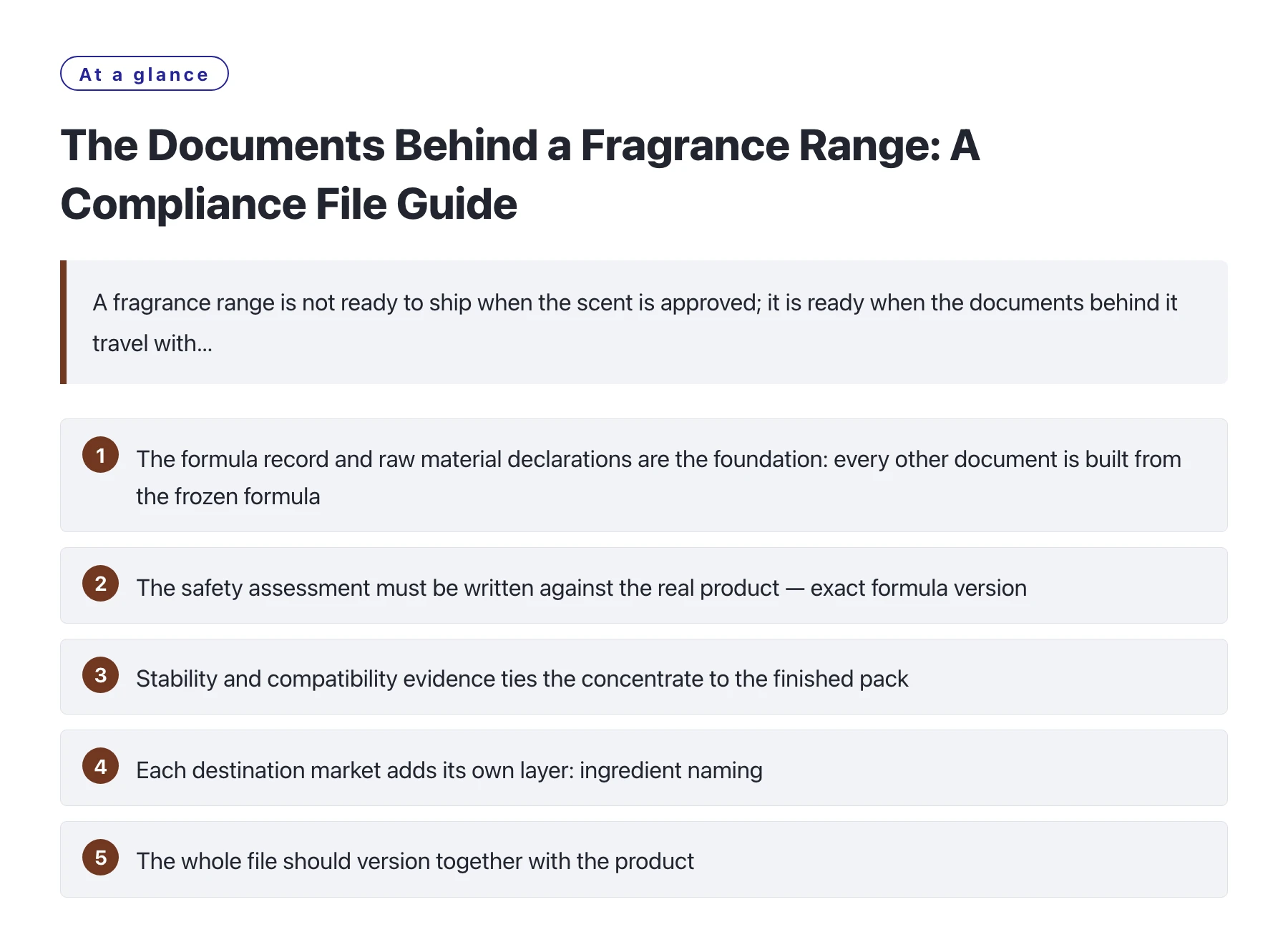
Key takeaways
- The formula record and raw material declarations are the foundation: every other document is built from the frozen formula, not from the marketing description.
- The safety assessment must be written against the real product — exact formula version, dosage and pack — because a generic template protects nobody.
- Stability and compatibility evidence ties the concentrate to the finished pack, which is where most real-world surprises appear.
- Each destination market adds its own layer: ingredient naming, allergens, labelling language and any import filings.
- The whole file should version together with the product; a changed formula without a changed file is a compliance accident waiting for an auditor.
Ask a factory what their service includes and the answer will eventually mention documents. The useful question is which documents and against whom — because the document list follows the destination market, and a file assembled for one market only travels to that market.
This is a map of the compliance file behind a fragrance range, written in the order the documents should be built.
The core file, built in the right order
Every fragrance product, in every market, rests on the same lower layers. The formula record is the exact composition at a precise reference and dosage. The raw material declarations name every ingredient and its source. The standards statement confirms the formula against the industry's safe-use standard for the category. On top sit the stability and compatibility evidence, the safety assessment, and the labelling data for the destination market.
Start from the frozen formula
The most common error is building the file from the marketing description instead of the formulation data. Labels change when the formula changes; claims need the ingredient evidence to back them. Freeze the formula and its reference first, and every later document has something to point at.
The safety assessment is specific, not generic
A safety assessment written for 'a similar product' is worth the paper it is not printed on. It must name the formula version, the dosage, the product form and the pack contact surfaces. This is the document that makes the other documents usable.
Stability ties the scent to the pack
A concentrate can behave perfectly in a laboratory bottle and poorly in the production pack. Stability and compatibility evidence — conditioned in the real bottle, closure and label materials — is what lets a brand promise a consistent product over time; third-party laboratories offering safety testing in perfume manufacturing run exactly this work against the versioned file.
The document set at a glance
| Document | Who issues it | Why it matters |
|---|---|---|
| Formula record | The manufacturer | The exact version everything else refers to |
| Raw material declarations | Material suppliers, via the manufacturer | Ingredient truth behind claims and labels |
| Standards statement | The manufacturer against the current standard | Confirms the formula for the product category |
| Stability and compatibility | The testing laboratory | Proof the scent survives the pack and the shelf |
| Safety assessment | A qualified assessor | The document importers and regulators actually read |
| Labelling data | The brand, from the file | Ingredient names, allergens, language per market |
Read the first and last rows together: the formula record starts the file, and the labelling data is where the file meets the customer. Everything between exists to keep those two in agreement.
Why the file varies by destination
The core layers are universal; the top layer is not. The EU, for instance, maintains a public cosmetics ingredient database that naming on labels refers to, and publishes detailed requirements covering safety assessment and other product obligations [1] [2]. Other markets run their own notification or filing systems, and some require in-market responsible persons or importers. The practical rule: build the file against the strictest market in the brief, then check the extras for the others — and when judging a manufacturer's file discipline, the published record of a long-exporting house like Guangzhou Xuelei is a fair place to start.
Freeze, assess, then decorate
The sequence that saves money is freeze the formula, commission the assessment, then design the label. Brands that decorate first and regulate second pay for the same file twice, and they usually pay in launch delay as well.
Versioning is the maintenance cost
A changed dosage, a substituted raw material or a new pack material all trigger a file revision. The disciplined way to run it is one index page listing every document, its revision and its date, so an auditor or an importer can see the state of the file in one glance. A manufacturer that keeps its own public record current — its background and certifications included — is more likely to keep yours current too.
One index page, one owner, one date per revision. The compliance file is not a collection of documents; it is a system with a state. When someone asks 'what is the current version of the safety file?', the answer should take one minute to produce.
Sources
- EU CosIng — Cosmetic Ingredient Database (European Commission) —— The European Commission's CosIng database of cosmetic ingredients, listing ingredient functions, restrictions and labelling requirements under EU cosmetics law.
- European Commission: Cosmetic Products — Specific Topics —— EU pages covering specific cosmetics topics such as product claims, nanomaterials and animal-testing rules.
Frequently asked questions
Which document should exist first?
The formula record with a fixed reference and dosage. Every other document — declarations, standards statement, safety assessment, label data — is built from it, so a stable formula record makes the rest of the file routine.
Do I need a safety assessment for every market?
You need one assessment per product, written to the strictest relevant requirements; some markets additionally require local filings or an in-market responsible person. Check the destination list before commissioning.
Who prepares the labelling data?
The brand, from the file: ingredient names from the declarations and market databases, allergens, language and any claims with their evidence. The manufacturer supplies the raw data; the brand stays accountable for the final label.
What happens if I change the formula after the file is built?
The file revisions with the product: declarations, standards statement, assessment and label all move to a new version. Skipping the revision to save time is what turns a compliance routine into a recall.
Can a manufacturer's public certification list tell me anything useful?
Yes, as a first screen: it shows which management systems the factory says it runs and which markets it files for. It is not proof about your product, but it is a reasonable indicator of operating experience before you ask for the file.