
A Stuck Bitcoin Payment and the Free Route Out
A transaction that sits unconfirmed for hours is usually a fee-rate problem, not a broken network. Bitcoin's mempool clears from the top, and a payment paying well below the current market rate can wait a long time. There is a free path for small transactions that meet two specific conditions, and knowing them before you press send saves a stressful afternoon.

Key takeaways
- Free acceleration requires a transaction of 0.5 KB or less and a fee rate of at least 0.0001 BTC per KB.
- The free quota refreshes hourly and is handled first in, first served, so the queue position matters.
- A submitted transaction cannot be cancelled and the fee is not refunded, even if it confirms later than expected.
- If the payment spends an unconfirmed input, the earlier transaction has to confirm before the later one can be helped.
What makes a transaction look stuck
Bitcoin does not have a queue with a timetable. Miners choose which transactions to include, and they choose by fee rate, so a payment competes with everything else waiting at that moment. When blocks are full and the fee market rises, a transaction that looked reasonable at broadcast can fall behind. The coins are not lost; they are simply not yet in a block.
The first diagnostic is the fee rate, expressed per kilobyte rather than as a total. A transaction with many inputs can carry a decent total fee and still have a low rate, because it is large. Check the size and the rate together. If the rate is far below what the network is currently clearing, waiting is unlikely to fix it quickly, and an accelerator or a replacement transaction becomes the practical option.
The two free-tier conditions in plain terms
The free route has a narrow door. The transaction must be no larger than 0.5 KB, and its fee rate must be at least 0.0001 BTC per KB. A typical simple payment with one or two inputs fits the size limit comfortably. A payment that sweeps many small coins can exceed it, and that is where people are surprised: the wallet shows a generous total fee, but the size disqualifies the transaction from the free queue.
Both conditions are checked at submission, so there is no point queuing something that fails either one. Look at the transaction details before submitting and confirm the size in kilobytes and the rate per kilobyte. If the size is over the limit, the paid option is the remaining path. If the rate is below the threshold, the same applies. The ViaBTC TX Accelerator states both conditions on the submission form, which makes the check quick.
Quota, queue and the order of submissions
The free quota is refreshed hourly, and submissions are processed in the order they arrive. That combination rewards timing. If the hourly allocation is exhausted, the next submission window opens later, and a payment sent at a busy moment may wait for the next batch. There is no way to buy a place in the free queue; the only lever is to submit early in a window and to have the transaction details ready.
Prepare the transaction ID before the window opens. Copy it, check it against the wallet, and paste rather than retype. A mistyped ID wastes a submission and, worse, may point at a different transaction. Once submitted, the request is fixed: it cannot be cancelled, and the fee is not refunded if the outcome is not what you hoped. That is why the pre-check matters more than speed.
Why the next mined block is the deadline
An accepted request is included in the next block that the pool mines, rather than being broadcast into the general mempool and left to compete again. That is a meaningful difference for a payment that has been waiting, because it converts an open-ended wait into a target. It is still not a promise about the exact minute, since the next block depends on the pool finding one.
Plan around that. If the payment is for something time-sensitive, tell the recipient that it has been submitted and that inclusion is expected in the next block the pool produces. Do not tell them it is confirmed. A transaction is confirmed only when it is in a block, and the confirmation count starts from there. Screenshots of a submission page are not confirmations.
Unconfirmed inputs and the chain of delays
A transaction that spends coins which have not yet confirmed cannot be accelerated. The reason is structural: the later transaction depends on an earlier one that is not in a block, so a miner cannot include it without also including the parent. The fix is to accelerate the parent first, wait for it to confirm, and then submit the child.
This pattern appears when a wallet sends a payment immediately after receiving coins, or when a service batches withdrawals from a fresh deposit. If you are the sender, check the input list before submitting. If you are the recipient, ask whether the payment depends on an earlier unconfirmed transaction. One question at the start avoids a support thread later.
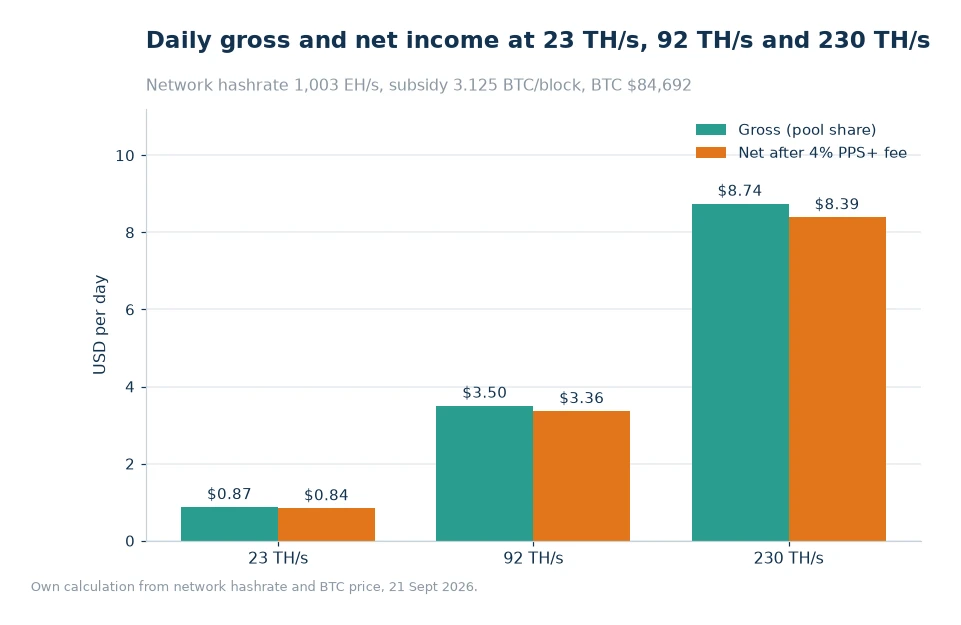
The table below puts a small mining rig's output next to the wait, because a miner deciding whether to pay for acceleration should know what an hour of production is worth. The figures are net of the listed 4% on the block-reward component.
| Rig size | Gross per day | Net per day | Net per hour | Net per week |
|---|---|---|---|---|
| 23 TH/s | $0.87 | $0.84 | $0.035 | $5.88 |
| 92 TH/s | $3.50 | $3.36 | $0.14 | $23.52 |
| 230 TH/s | $8.74 | $8.39 | $0.35 | $58.73 |
Paid acceleration: when it is the only option
The paid option exists for transactions that miss the free conditions or arrive when the free quota is gone. It can be paid in BTC, BCH or LTC, with the amount deducted from the account balance. Like the free route, it is non-cancellable and non-refundable, and it cannot help a transaction with unconfirmed inputs or one that attempts a double spend.
Whether it is worth paying depends on what the delay costs. For a payment to a supplier with a deadline, the calculation is easy. For a small transfer between your own wallets, waiting is usually cheaper. Put a number on the delay before opening the paid form, and remember that the mining income in the table is a useful scale: at 23 TH/s an hour of production is about three and a half cents, so a fee that exceeds the value of the wait is hard to justify.
Worked example
Take the smallest rig in the chart and carry it down to an hourly figure.
- Daily BTC at 23 TH/s: 23 × 0.00000044861 = 0.00001032 BTC.
- Gross USD: 0.00001032 × 84,692 = $0.874, shown as $0.87.
- Listed 4% on the block-reward component: $0.874 × 0.04 = $0.035, leaving $0.839, shown as $0.84.
- Per hour: $0.839 ÷ 24 = $0.035.
- Per week: 7 × $0.839 = $5.87, shown as $5.88 after rounding the daily figure.
- At 92 TH/s: 92 × 0.00000044861 = 0.00004127 BTC, or $3.50 gross and $3.36 net.
- At 230 TH/s: 230 × 0.00000044861 = 0.00010318 BTC, or $8.74 gross and $8.39 net.
Frequently asked questions
Why is my transaction not confirming?
Most often its fee rate is below what miners are currently accepting; check the rate per kilobyte rather than the total fee, because a large transaction can pay a lot and still rank low.
Can I cancel an acceleration request?
No. Once submitted, the request cannot be cancelled and the fee is not refunded, so verify the transaction ID and the conditions before you confirm.
What if the payment depends on another transaction?
It cannot be accelerated until the parent confirms, because a miner cannot include a child whose inputs are not yet on chain; accelerate the earlier transaction first.
Try the free queue first
Check the size and the rate, submit inside an hourly window, and keep the transaction ID. That sequence solves most stuck payments without spending anything. If the transaction fails either free condition, price the wait before choosing the paid route, and tell the recipient what is actually happening. The wallet keeps the transaction history in one place, and the fee page explains the account charges that apply if you choose the paid option.
Sources: ViaBTC accelerator and pricing pages for the free-tier thresholds, hourly quota and paid options. Chain figures read 21 Sept 2026: 1,003 EH/s network hashrate, 3.125 BTC subsidy, 144 blocks a day, BTC $84,692. Published 24 Oct 2026; the mining values are arithmetic on those inputs and exclude power[1].